
Registration 15 Aug – 15 Oct 2026
Interlaboratory Studies (ILS)
Setting new milestone for refractory testing.
Interlaboratory comparisons to validate, benchmark, and improve the accuracy of your refractory testing methods.
Interlaboratory Studies (ILS), also known as round-robin tests, are planned exercises in which at least two laboratories perform tests or measurements on same or identical samples under prespecified conditions. They enable an objective assessment of the precision, accuracy, and reliability of testing methods, as well as the technical competence of individual laboratories, by comparing the results from different laboratories.
- open to the entire value chain
- anonymous proficiency test
- benchmark report included
Pilot project · CCS
Cold Crushing Strength
How it works
Six steps from registration to report
Samples are distributed centrally, tested locally, and evaluated across all participants — every step with a clearly defined responsibility.
-
02
FGF
Sample preparation
Homogeneous samples of refractory bricks will be distributed to the participating labs.
-
03
Labs
Testing in labs
Laboratories prepare test pieces and perform the relevant tests according to a standardised method (e. g. CCS).
-
04
Labs → FGF
Data submission
Results are submitted to FGF for centralized analysis.
-
05
FGF
Statistical analysis
The data are anonymised and analysed for precision, accuracy and comparability across laboratories.
-
06
FGF → Labs
Reporting and insights
Participants receive a detailed report that includes benchmark data and, if relevant, suggestions for improvement.
Why they matter
A structured framework for better test results.
Proficiency testing (PT) provides an external quality assessment to evaluate and compare the performance of laboratories through interlaboratory comparisons, ensuring accuracy, reliability, and consistency of test results.
- 01
Customer trust
By demonstrating the accuracy and transparency of your test results, you can strengthen your customers' trust in your products and services.
- 02
Harmonize methods
Ensure all laboratories follow the same protocols, reducing variability in results.
- 03
Validate methods
Confirm that a testing procedure is reliable, repeatable, and reproducible across different environments.
- 04
Improve precision
Identify sources of error (e.g., equipment, operator technique) and refine methods to minimize them.
- 05
Establish best practices
Create guidelines or standards (e.g., ISO, DIN, or industry-specific) that define how tests should be conducted to achieve consistent results.
Certified Reference Materials
From comparison data to certified materials
ILS generate data that can be used to develop Certified Reference Materials (CRM): consistent, stable materials with well-defined properties, certified by a technically valid procedure.
Calibration tools
Labs use CRMs to calibrate equipment and verify that their measurements are accurate.
Quality controls
CRMs allow labs to monitor their performance over time and compare results with other labs.
Benchmarking
They provide a common reference point for evaluating the accuracy of new methods or materials.
Until now, no interlaboratory studies on refractory products have been open to all actors of the refractory value chain, nor have any certified reference materials been established. FGF addresses this issue.
Pilot project
Cold Crushing Strength as the first method
The Modulus of Rupture (MoR) and Bulk Density (BD)/Open Porosity (oPo) will follow shortly after.
Timetable
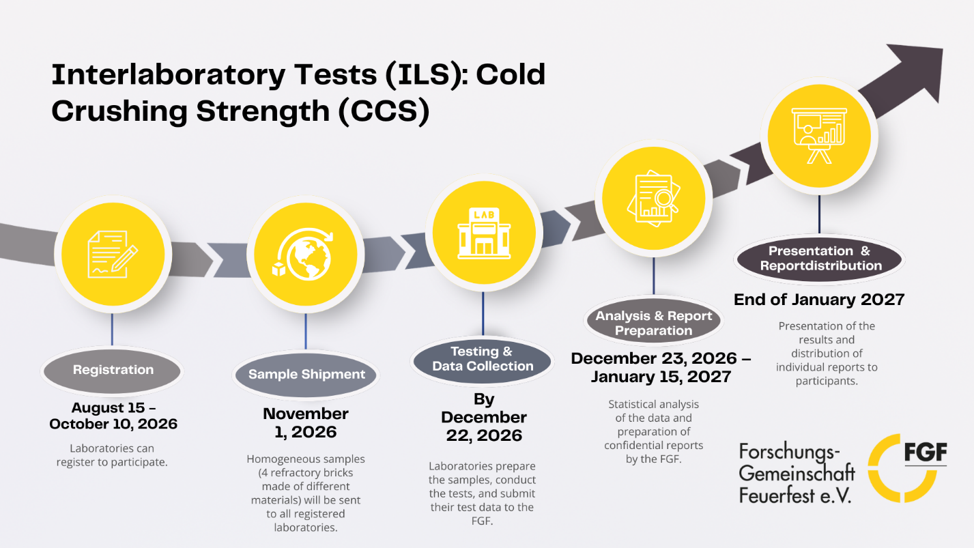
ILS CCS schedule
The pilot runs on a fixed schedule from registration to the presentation of results.
Documents
Project description
Full details of the objectives, methodology and timetable can be found in the project description, available in English and German.
Your costs
Participation
- ILS Cold Crushing Strength1,600.00 €
- VATplus
- Shipping feeby destination
- Net per lab1,600.00 €
The cost for participating in the ILS for refractory products with the Cold Crushing Strength (CCS) test is 1,600 € plus VAT per laboratory. Additionally, a shipping fee applies, which varies depending on the destination.
Questions?
Kerstin HaukeQuestions
Frequently asked questions
All refractory producers, independent testing laboratories, and refractory product consumers (e.g., steelmakers, foundries). Research institutions and associations are welcome.
To begin with, we will consider the Cold Crushing Strength (CCS). The Modulus of Rupture (MoR) and Bulk Density (BD)/Open Porosity (oPo) will follow shortly after.
The plan is to hold annual sessions for each method, depending on demand.
In principle, additional testing methods are possible, depending on demand. We will periodically check to see if there is interest in additional testing methods.
For any further questions, the team of Forschungsgemeinschaft Feuerfest e. V. is available at any time at
Personal contact
Ready to take part?
Kerstin Hauke supports you with organisational and technical questions about participation.